Upcoming and past webinars
Note: some webinar slide decks may be available on request. Please contact info@powc.us.
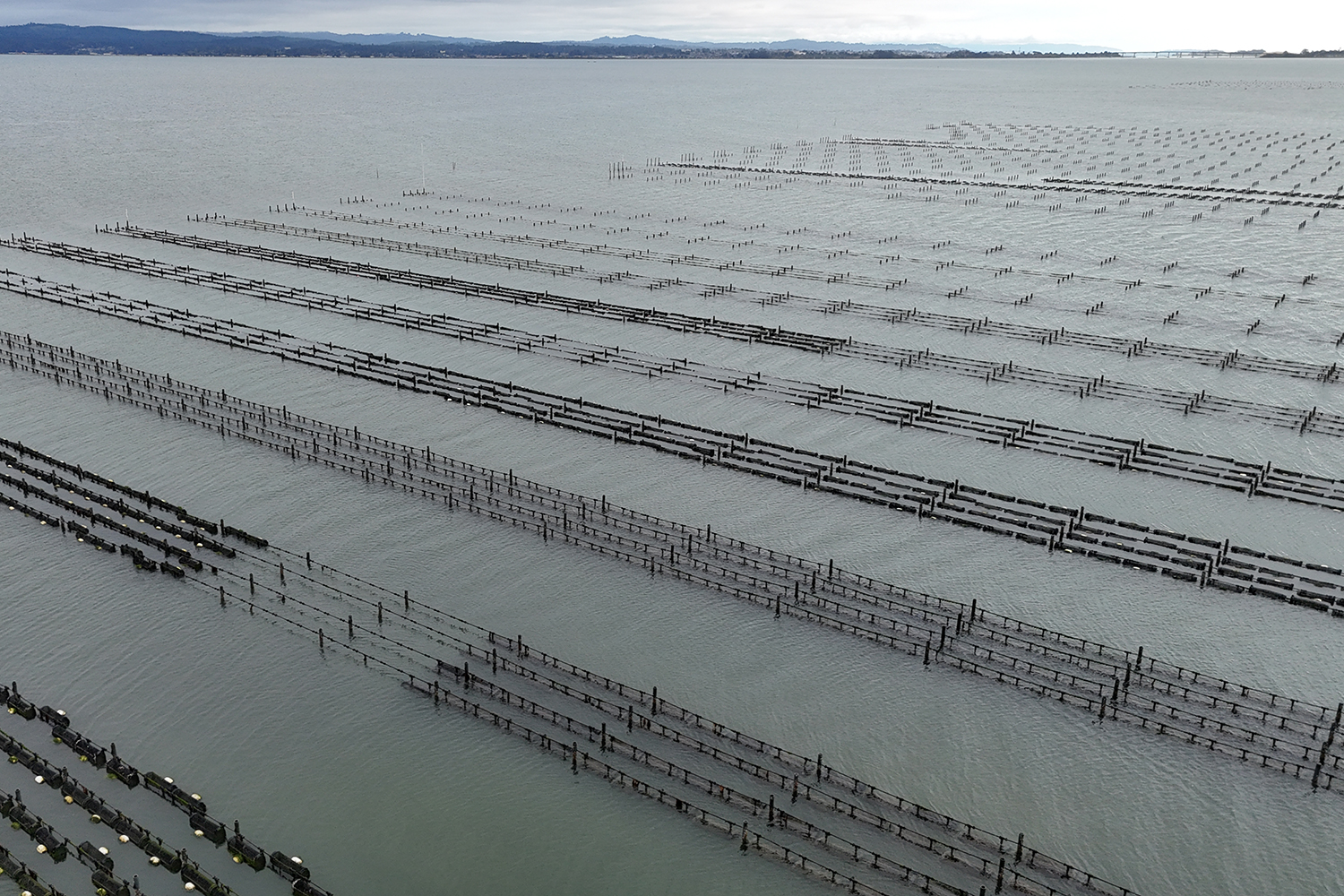
Balancing offshore wind port infrastructure with existing coastal industries: perspectives from the Humboldt Bay shellfish industry
Tuesday, October 13 from 2-4 pm (Pacific).
Port infrastructure is a critical part of deploying floating offshore wind. In California, only two ports – Long Beach and Humboldt Bay – are currently considering developing staging and integration facilities, where turbines could be assembled and then towed offshore for installation.
Understanding what it means to develop these large-scale port infrastructure projects requires meaningful engagement with the communities and industries currently occupying those spaces. In a partnership with California Sea Grant, the Schatz Energy Research Center has been supporting this type of engagement for the CA North Coast, including with the shellfish industry in Wigi / Humboldt Bay.
This webinar will include presentations from California Sea Grant and the Schatz Center about their work with Humboldt Bay shellfish farmers over the past two years, and perspectives from local shellfish farmers who have participated in these efforts and are actively engaged in the development process. Our goal is for attendees to come away with a better understanding of Humboldt Bay as a working estuary and agricultural space, and of the concerns and priorities of the shellfish industry regarding large-scale port development.
Presenters & panelists will include Tanner Etherton (Schatz Energy Research Center & California Sea Grant), Kevin Johnson (California Sea Grant), Justin Mojonnier (Hog Island Oyster Company), and Todd Van Herpe (Humboldt Bay Oyster Company).
This talk is a production of the Pacific Offshore Wind Consortium and the Schatz Energy Research Center. For questions about this webinar or to request technical or accessibility support, please contact us at schatzenergy@humboldt.edu or call 707-826-4345.
Past webinars: info and videos
Introducing the California Offshore Wind Environmental Monitoring Framework (6/23/26)
Over the last two years, the California Marine Sanctuary Foundation (CMSF) has worked with over two hundred scientists — in coordination with the California Ocean Protection Council and California Department of Fish and Wildlife — to develop a statewide Environmental Monitoring Framework for floating offshore wind development. This framework provides a science-based foundation to guide the development of site-specific monitoring plans for species, habitats, and oceanographic processes that may be affected by floating offshore wind in California. It identifies potential environmental impacts from OSW development, proposes relevant monitoring questions, and reviews available and emerging monitoring tools.
Join us on June 23 for a discussion with CMSF and Cal Poly San Luis Obispo on monitoring recommendations and other next steps.
Designing Sensors to Detect and Reduce Marine Entanglement (6/17/26)
“Ghost gear” is the evocative term for lost, discarded and abandoned fishing gear found in the marine and coastal environment. This gear can create multiple hazards for marine life. Secondary entanglement refers to situations where ghost gear becomes entangled with existing infrastructure – creating a new entanglement hazard. The Schatz Center is leading research efforts to support advancements in environmental monitoring for mooring lines used to anchor floating offshore wind farms. Our goal is to expand the capacity of underwater sensors and remote operated vehicles to detect (a) primary entanglements between ghost gear and mooring lines, and (b) secondary entanglements between mooring-line-entangled ghost gear and transiting marine species. Our study focus is the deepwater environment of the Humboldt and Morro Bay Wind Energy Areas (WEAs) off the coast of Northern and Central California.
In order to assess detectability, we first need to characterize: (i) species of concern within these areas, (ii) ghost gear found within this region, and (iii) the metocean environment within the WEAs. (Note: metocean data is key for evaluating the sensor-signal to background noise ratio.)
Our first report, prepared by the Schatz Center and our partner colleagues at H.T. Harvey & Associates for the MoorSEA project, provides a high-level overview of the environmental and biological data associated with the Humboldt and Morro Bay WEAs.
Offshore Wind Jobs: Preparing Northern California Tribes and Local Communities (11/12/25)
Join us for a discussion of current workforce development efforts to prepare Northern California Tribes and local communities for jobs in the offshore wind and related renewable energy sectors. Presentations will include findings from Humboldt County’s Offshore Wind Workforce Assessment, commissioned by the Humboldt County Workforce Development Board, a Board of the County of Economic Development Division, and from a recent Schatz Center report on professional labor demand in California’s floating offshore wind industry. Presenters will also highlight workforce development programs helping to prepare community members for offshore wind jobs, including the Ta’m Resiliency Campus at Blue Lake Rancheria and the Humboldt Multi-Craft Core Curriculum (MC3) Apprenticeship Readiness Program.
Presenters:
- Andy Logan, Head of Industry Development, US, Xodus – Humboldt County Offshore Wind Workforce Assessment
- Tanner Etherton, Economic Analyst & Offshore Wind Extension Specialist, Schatz Energy Research Center, Cal Poly Humboldt – Professional Labor Report & POWC workforce initiatives
- Heidi Moore-Guynup, Director of Tribal and Government Affairs, Blue Lake Rancheria – Ta’m Resiliency Campus and workforce development in renewable energy
- Andie Rix, Workforce and Economic Development Specialist, University Advancement, Cal Poly Humboldt – Humboldt Multi-Craft Core Curriculum (MC3) Apprenticeship Readiness Program
Permitting for offshore wind port infrastructure projects (7/10/25)
For offshore wind energy projects to be developed in California, specialized port facilities—known as “staging and integration” sites—must be built to stage, assemble, and integrate massive floating offshore wind turbines before they are towed out to the designated offshore wind energy areas. This webinar will describe the key findings from our recently published report, Permitting for Port Infrastructure to Support Offshore Wind in California, and discuss permitting requirements for staging and integration sites, including those relating to Tribal consultation and public engagement. The presentation will be followed by a panel discussion with staff from the California State Lands Commission and California Coastal Commission to discuss each agency’s role in permitting these types of projects.
Panelists:
- Moderator: Awbrey Yost, Senior Policy Analyst, Schatz Energy Research Center
- Amy Vierra, Renewable Energy Specialist, California State Lands Commission
- Catherine Mitchell, North Coast Harbor Analyst, California Coastal Commission
- Dani Ziff, South Coast District Supervisor, California Coastal Commission
What does it take to grid-connect offshore? Cable Laying and Monitoring at PacWave (5/12/25)
PacWave is a state-of-the-art, pre-permitted, grid-connected, wave energy test facility. It is being developed in partnership with the US Department of Energy, the State of Oregon, Oregon State University, and local stakeholders. The open ocean test site consists of four berths, which occupy two square nautical miles of ocean with a cable to shore of approximately 12 miles in length (for each berth). Drilling for cable conduits began in summer 2021 and cable laying was completed in fall 2024; however, permitting and cable procurement started long before that. This webinar will describe the cabling process, including pre-installation environmental surveys and post-installation monitoring.
Dan Hellin is the Director of the PacWave wave energy test facility, and Sarah Henkel is the Associate Director of the Pacific Marine Energy Center at Oregon State University.
West Coast Perspectives on Ocean Renewable Energy (2/25/25)
What factors influence people’s different responses to proposed offshore wind and wave energy developments – and what might the implications for future siting and permitting processes be? In this talk, Hilary Boudet and Gregory Stelmach of Oregon State University shared insights from their ongoing studies of community perspectives toward marine renewables development.
Hilary Boudet is a Professor and Director of Graduate Programs in the School of Public Policy at Oregon State University. Her research interests include environmental and energy policy, natural resource sociology, social movements, and public participation in energy and environmental decision-making. Greg Stelmach is a Postdoctoral Scholar in the School of Public Policy at Oregon State University and the Pacific Marine Energy Center.
Seabirds in 3D: a framework to evaluate collision vulnerability in future offshore wind developments (9/24/24)
Research led by the Schatz Energy Research Center in collaboration with H. T. Harvey & Associates evaluates the tradeoffs between the collision vulnerability of 44 seabird species and the offshore wind power-generation potential along California’s coast. This work will improve understanding of seabirds in 3D and help evaluate potential locations for future wind energy developments with minimized impact to seabird populations.
This webinar was presented by Eli Wallach and Arne Jacobson of the Schatz Center, Stephanie Schneider and Sharon Kramer of H. T. Harvey & Associates, and Lisa Ballance of Oregon State University.